


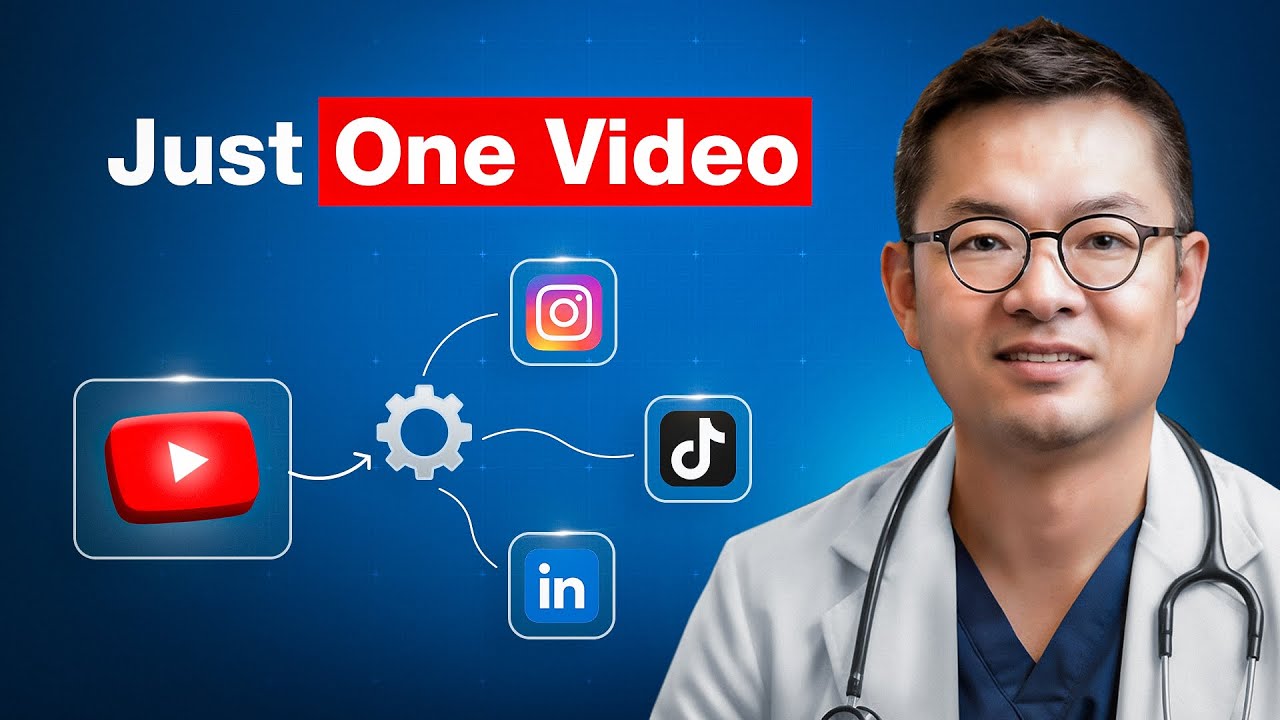
Let me hit you with a startling truth: I once powered my clinic’s entire monthly marketing engine with a single eight-minute video—recorded during a lunch break, mind you, while eating leftover pasta. It wasn’t fancy. There were awkward pauses and a cat cameo. Yet, that one scrappy video turned into weeks of Instagram posts, YouTube Shorts, and even a podcast. You don’t need a film crew or unlimited time—just a system, some honesty, and a willingness to look a little silly while you learn.
One Video, Endless Value: Flipping 8 Minutes into 30 Days of Content
What if I told you that just eight minutes of recording could fuel your entire month of healthcare content marketing? You don’t need a fancy studio or a big marketing budget. All you need is your phone, a quiet room, and the willingness to answer the questions your patients ask every week. This is the core of my video content creation strategy, and it’s how I help private practice doctors grow without depending on insurance or expensive agencies.
Start by choosing a single, focused patient education video topic each week. Think: “ACL recovery tips,” “aligners vs. braces,” “posture tricks for desk workers,” “hormone balance basics,” or “simple acne routines.” These are the real questions patients bring up in your office. If you’re stuck, use AI tools like ChatGPT or Gemini to brainstorm patient education video topics and script ideas. AI can help you cluster topics and find long-tail keywords that match exactly what patients are searching for—improving your medical SEO and increasing your chances of showing up in search results.
Your first take might feel awkward. That’s normal. In fact, real is better than perfect. Patients want to see a doctor who’s relatable, not a polished actor. A good rule of thumb: ask yourself, “Would my sibling understand this?” If yes, you’re on the right track. That’s your gold standard for effective content marketing strategies in healthcare.
Once you’ve recorded your eight-minute video, your job is really done.
Every video after that gets better. Once you’ve recorded that raw video, your job is really done.
From here, you or your team can slice that video into short clips, quotes, blog posts, social media snippets, and even email tips—enough to fill 30 days of content calendars. The beauty of this system is that it runs almost entirely on autopilot after your initial recording.
- Start with one focused video each week
- Keep topics simple and patient-centered
- Use AI for brainstorming and scripting
- Embrace imperfection—authenticity wins
With this approach, you’ll consistently create valuable, search-friendly content that attracts and educates patients—without breaking a sweat.
Let AI (and a Good VA) Do the Heavy Lifting: My “Almost-Autopilot” Workflow
Here’s the truth: you don’t need to spend hours editing, captioning, or uploading your videos. Once you’ve recorded your weekly 8-minute patient education video, let AI tools and a reliable Virtual Assistant (VA) do the rest. This is the heart of AI Tools Video Marketing and Virtual Assistant Video Marketing—and it’s how busy healthcare professionals stay consistent on YouTube and social media without burning out.
- Hand off the grunt work: Your VA or video editor handles all the technical steps—editing, adding captions, uploading, and scheduling. You focus on the message; they handle the mechanics.
- Repurpose with AI: Upload your long-form video to Opus.pro. In less than 10 minutes, it automatically finds the best 30-60 second moments, adds captions, and creates 10-15 short, punchy clips ready for Instagram, TikTok, LinkedIn, and YouTube Shorts.
- Expand your reach: Take your video transcript and use Notebook LM to turn it into a podcast episode. Now you’re reaching commuters and multitaskers, multiplying your patient attraction video impact.
Don’t worry if the tech feels intimidating. My first attempt at video editing involved exporting a file upside-down! You’ll get the hang of it, and your VA can guide you through the basics. The key is to start—every video gets easier, and the results speak for themselves.
You just went from one video to 15 pieces of content in less than 10 minutes.
Case studies in healthcare marketing show this works. Take Dr. Alex Kim, a Dallas podiatrist. He started using this workflow six months ago. Now, he gets three to five new patients per week who say, “I watched your videos about plantar fasciitis.” That’s the power of YouTube Healthcare Professionals and smart Patient Attraction Video strategies.
Let AI and your VA do the heavy lifting. You handle the brains—topic, script, and message. They handle the hands—cutting, posting, and repurposing. That’s how you build a content machine that attracts patients 24/7, without breaking a sweat.
Turn Video into SEO Rocket Fuel: Blogs, Site Visits, and the Google Effect
Forget cold calls and expensive ads—consistent educational video content is the true engine of modern Healthcare Content Marketing and Medical SEO. When you transform your eight-minute video into a blog post and embed your YouTube video right on your site, you unlock a powerful SEO flywheel. Here’s how I do it, step by step:
1. Embedded YouTube Videos: The Engagement Multiplier
First, I embed my YouTube video into a blog post. The embedded video keeps people on your page longer, which tells Google your content is valuable. This “dwell time” is a direct SEO signal. The longer patients stay, the more Google trusts your site as an authority in your specialty.
2. Transforming Video Content into Blogs: The Keyword Advantage
Next, I transcribe my video and turn it into a detailed blog post. This lets me target those juicy long-tail medical keywords—exactly what patients type into Google when searching for answers. The result? More opportunities for Keyword Research Medical SEO and higher rankings for a wider range of search terms.
3. Double Your Keyword Rankings with Video
Marketing studies show that web pages with embedded YouTube videos can rank for up to twice as many keywords as those without. That means more eyeballs, more trust, and ultimately, more bookings. Plus, since YouTube is part of the Google family, you’re feeding Google its favorite content format, boosting your exposure in searches, maps, and video panels.
4. Multi-Platform Scheduling: Work Once, Appear Everywhere
After creating my blog and video, I let AI tools generate a podcast version to reach patients who prefer audio. Then, I use Vista Social Multi-platform Scheduling to schedule everything—Instagram, TikTok, Facebook, LinkedIn, and YouTube Shorts—all from one dashboard. I personally use Vista Social… a huge time saver. No need to share logins or juggle multiple apps; my team can follow a simple process, and I can focus on patient care.
- SEO Benefits YouTube Videos: More keywords, higher engagement, stronger authority.
- Transforming Video Content Blog: Reach patients through search, video, and audio.
- Vista Social Multi-platform Scheduling: Consistent presence, zero hassle.
Wild Cards: Digital Twins, Real-Life Oopsies, and the Secret Sauce (Hint: It’s Not Just Tools)
Let’s talk about the wild cards that make my Content Machine Workflow for Doctors truly unstoppable: digital twins, real-life mishaps, and the not-so-secret sauce that holds it all together. With advances in AI Voice Cloning Content Delivery, I can now create podcast episodes, video snippets, and even entire scripts using nothing but a few minutes of my own voice. Tools like ElevenLabs and HeyGen let you build a digital ‘doppelgänger’—your AI twin who can keep delivering healthcare content marketing even while you’re in clinic or on vacation.
Your digital twin works while you’re in clinic or on vacation. Imagine that.
But here’s the twist: it’s not just about flashy tools. The real secret is building a system that keeps running, even when you’re not around. I’ve had days where my tech crashed, my team was out sick, or I spilled coffee all over my notes (true story—my most-watched video literally starts with that moment). Yet, because I have a routine and clear workflow, the content keeps flowing. Whether you’re using Podcast Creation Video Transcripts to repurpose interviews or leveraging AI for voice and video, the magic happens when you blend automation with human authenticity.
Healthcare content marketing has to walk a fine line—engaging patients and professionals while staying compliant with privacy rules like HIPAA. That’s why I always recommend systematizing your process. When you have a routine your team can follow, you’re protected from the chaos of vacations, sick days, or the occasional tech meltdown. And when you let those real-life oopsies show through, your audience connects with you on a human level. Authenticity hits harder than a flawless edit, every time.
So, next time you think you don’t have time for marketing, remember: you don’t need more time, you need better systems. Experiment with AI voice cloning, embrace the imperfect moments, and let your content machine do the heavy lifting. That’s the real secret sauce—and it’s how I turn eight minutes into a month of patient-attracting content, without breaking a sweat.
TL;DR: If eight minutes of video can feed your marketing for a month, imagine what a simple system can do for your practice. Skip the burnout, embrace automation, and let your content work for you—even if you’ve only got a lunch break and a cat for company.