


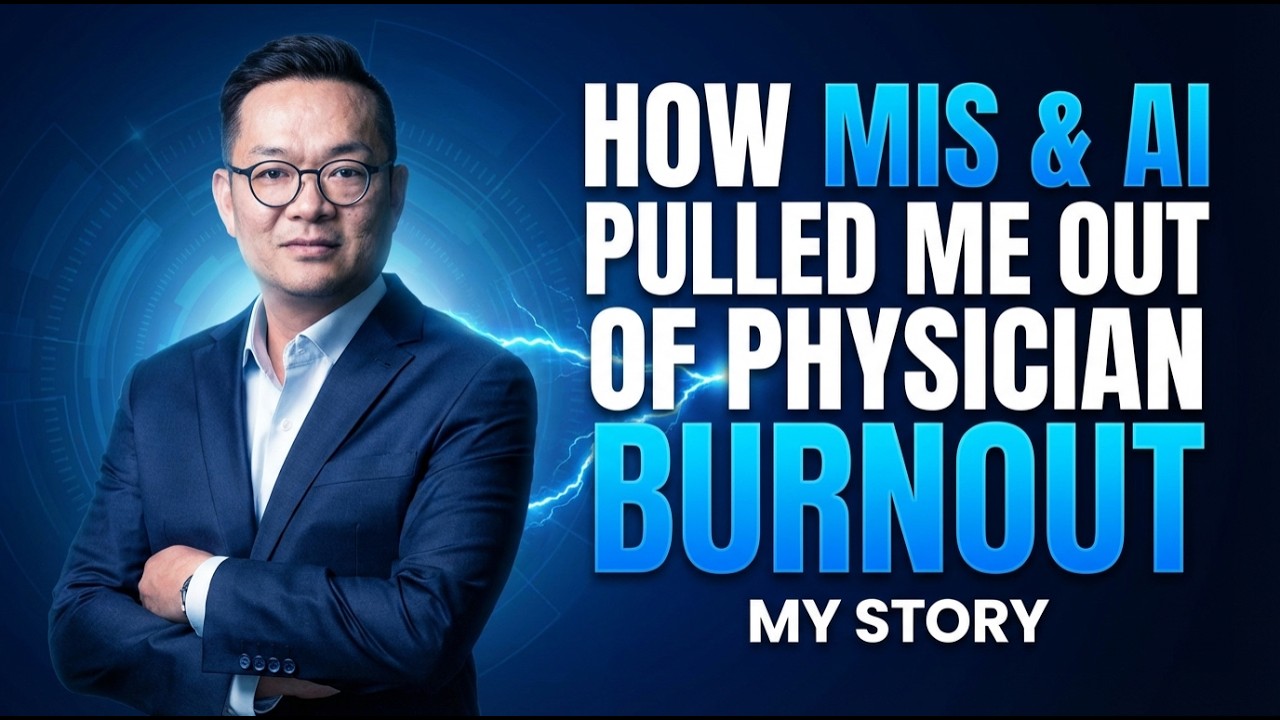
I used to think seeing more patients was the only way to win. Between 2012 and 2014 I hit a wall: physical exhaustion, resentment, and the urge to quit medicine. This post walks through how a niche clinical model (MIS + hybrid concierge) gave me clinical and financial leverage — and how AI, starting in 2022 for me, provided the operational leverage to scale that model without burning out. I’ll share tools, practical workflows, and the hard data that convinced me to shift.
1) Personal burnout diagnosis — more than just hours
I graduated from Shaw College of Podiatric Medicine in 2001, started practicing in 2003, and opened my own practice in 2007. My Physician Burnout didn’t hit on day one—it built up and peaked around 2012–2014, when value-based care pressures rose and reimbursement dropped. I was running three clinics, moving equipment between locations, and managing five or six employees. I was “young and hungry,” convinced volume would save me.
“I basically thought if you see as many patients as possible, you’ll do fine.” — Dr. TJN
But Clinician Burnout wasn’t just about long hours. My body started to refuse to work. I felt resentful, like I was stuck in a rat race with no north star. That’s when I asked the question that changed everything: Is this too much work, or the wrong work?
“Is that really burnout from too much work or you’re doing the wrong work?” — Dr. TJN
Research backs this up: burnout often comes from systemic friction and lost fulfillment, not only time on the clock. For me, the Cognitive Burden of constant throughput erased Work-Life Balance. I even considered leaving healthcare entirely to pivot into entrepreneurship.
2) MIS + Hybrid practice: the niche that bought me time
Hybrid practice model + Patient Experience: my 2014 pivot
In 2014, I found MIS—minimally invasive foot and ankle surgery. For a podiatrist, it was an epiphany: I didn’t have to “do it the old way.” MIS improved the Patient Experience with smaller incisions and faster recovery, but it also gave me something I didn’t expect: a new business lane. Niche clinical skills create clinical and financial leverage, so I could rely less on pure volume—one of the drivers of Physician Burnout.
“MIS gave me that niche side, the clinical leverage uniqueness.” — Dr. TJN
Why I chose a safer hybrid concierge path
I built a Hybrid practice model: a blend of insurance care and self-pay/direct pay. That mix hedged business risk and created breathing room, especially after years of managing 3 clinics and 5–6 employees. I’ve seen doctors try to go cash-pay cold turkey and struggle—not because they’re bad clinicians, but because entrepreneurship is a separate skill set.
Commitment + Clinical Documentation discipline
I learned quickly: you can’t be halfway in. Standardizing Clinical Documentation and committing fully to MIS workflows accelerated growth.
“You cannot get into it halfway. Commitment is very important.” — Dr. TJN
3) Why AI is operational leverage (my mindset shift)
When Artificial Intelligence really arrived for me in 2022, it changed my operating system. I stopped seeing AI Tools as “one more thing to learn” and started treating them as leverage—an operational multiplier that makes work better, faster, cheaper.
“AI makes it better, faster, cheaper.” — Dr. TJN
The breakthrough is that modern Generative AI comes pre-trained. You don’t need to build models or write code. You implement it, then refine it with prompts—using plain language the way you already think and speak in clinic.
“You don’t need to be a programmer. You don’t need to have a technical knowledge background.” — Dr. TJN
That matters for burnout because the biggest pain isn’t medicine—it’s the administrative burden. LLMs and Ambient AI can automate parts of documentation, inbox triage, and patient-friendly summaries, reducing cognitive load and cutting time spent after hours.
- Think “hireable helpers”: pre-trained agents you can deploy at near-zero marginal cost.
- Focus on workflow: where decisions repeat, where notes drag, where handoffs break.
- Ignore the noise: people debate “conscious” agents; I don’t fixate on that. I focus on practical leverage.
4) Practical tools I use every day (Google Gemini ecosystem + more)
I’m a big believer in AI tools healthcare that fit into my existing workflow, so I lean on the Google Gemini ecosystem plus a few focused clinical tools.
Google Workspace + Gemini for daily teamwork
“I use Google — Gmail, Google Docs, Google Sheets — because of capability of sharing.” — Dr. TJN
Because my team already lives in Gmail, Docs, and Sheets, Gemini support inside Workspace helps me draft Patient Communication, organize tasks, and quickly summarize long threads without jumping between apps.
Notebook LM for safer, source-limited writing
“Notebook LM … you can give them sources so that you can also limit AI’s capability.” — Dr. TJN
Notebook LM is my beginner-friendly powerhouse. I upload trusted sources (clinic handouts, guidelines, FAQs) so the model stays constrained—an approach that can reduce hallucination. I use it like a research assistant for patient education and marketing drafts, while keeping control of the source material.
Multimodal tools + AI scribes for Clinical Documentation
For visuals, Gemini’s image model (“nano banana”) speeds up patient-facing assets. For Clinical Documentation and EHR Notes, I also evaluate ambient scribe tools like Nuance DAX, Abridge, Ambience, Suki, and Nabla to draft notes and triage messages faster.
5) Evidence & numbers — what the research shows
Documentation Time & Administrative Burden: measurable wins
When I evaluate AI for Burnout Reduction, I start with hard metrics. Across studies summarized from UCLA, GE Healthcare, and a PMC review, ambient AI scribes and note-drafting tools consistently cut Documentation Time—with reported ranges of 8.5%–40% depending on workflow, specialty, and EHR setup. That matters because physicians can spend up to 28 hours/week on Administrative Burden before AI.
“Tools such as Nuance DAX, Abridge, Ambience, and Suki draft EHR notes from patient conversations automatically.” — Source summaries
Burnout Reduction & Pajama Time: what changes
Several AI scribe studies show burnout moving in the right direction, with examples like 52% → 39% and 69% → 43%. A UCLA study reported about a 7% improvement in burnout scores versus controls. In operational terms, AI-assisted triage and inbox support can cut Pajama Time by roughly 1–2 hours nightly, improving work-life balance.
Numbers that help leadership say “yes”
- Radiology: 33% faster breast ultrasound reads with AI, no accuracy loss
- Quantified time-saved makes pilot ROI and change management easier
6) Quick implementation roadmap — small experiments, big wins
I treat AI like operational leverage: start small, prove value, then scale. As Dr. TJN says, “AI is something you need to implement. It comes pre-trained.”
Pick one workflow and run a 4–8 week pilot
- Streamlining Documentation: post-visit note drafting
- Chart Prep: summarize prior notes, meds, imaging, and open loops
- Portal message triage: draft replies and route to the right bucket
Small pilots quickly surface ROI and clinician acceptance. For 4 weeks, I track baseline vs. AI-assisted minutes per chart and nightly “pajama time.”
Use constrained tools + human oversight
For clinical notes, I use Notebook LM or constrained LLMs with tight prompts and approved templates. Human oversight plus constrained LLMs minimizes risk while maximizing Time Savings.
Train staff to run “agents” as assistants
“Augment them. Hire them at almost no cost and they’re pre-trained.” — Dr. TJN
I assign clear roles (draft, verify, file) and protect privacy while checking EHR compatibility.
Typical outcomes: 8.5%–40% less documentation time, 1–2 hours less pajama time, and ~7% burnout score improvement (UCLA), supporting Efficiency Well-being.
Wild cards: two thought experiments and a quote
Thought experiment #1: AI Tools for Administrative Tasks
In my private practice, I ask leaders to try a simple “what if” to lower the Cognitive Load without getting technical. Replace one FTE admin (about 20–30 hrs/week) with a suite of AI agents that handle scheduling nudges, prior-auth drafts, inbox triage, and referral follow-ups. A month later, what does my calendar look like? Fewer after-hours clicks, fewer interruptions, and more protected patient time. The cost might be $X–$Y/month depending on the stack, but the reclaimed hours are the real budget line.
Thought experiment #2: Ambient notes with clinic-only protocols
Now imagine ambient AI that drafts post-visit notes and orders, with perfect citations limited to our clinic protocols. I review, edit, and sign—fast. That’s not replacing judgment; it’s removing friction.
Quick aside: people say AI agents may develop “consciousness.” I’m not sure I buy it, but there’s even social media for agents—and they already complain about humans. Wild.
“AI makes it better, faster, cheaper.” — Dr. TJN
These hypotheticals help teams visualize the future and reduce resistance. Start with small, safe pilots, measure impact, and iterate.
TL;DR: I escaped clinician burnout by pairing a niche hybrid MIS practice with ambient AI tools (Google Gemini ecosystem, Notebook LM, AI scribes). The result: less charting, fewer admin hours, better patient connection, and a scalable model.