


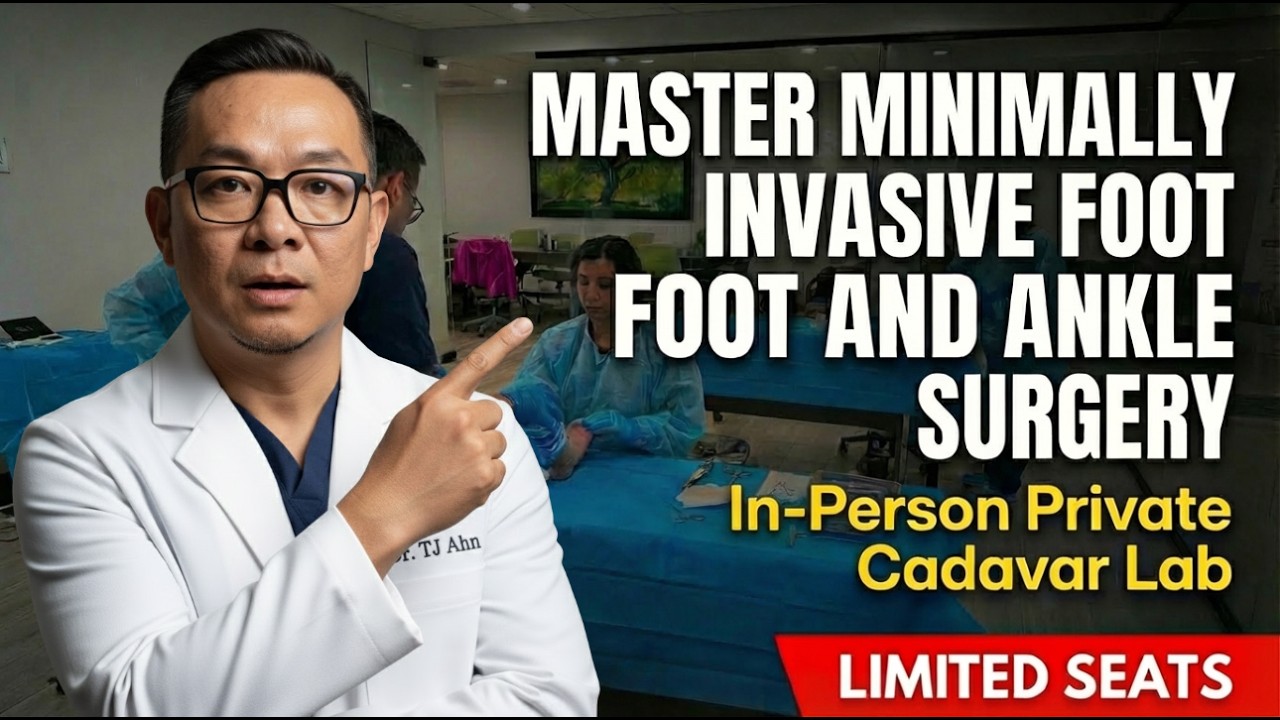
Master Minimally Invasive Foot Surgery: 2-Day Private Cadaver Lab is built for podiatrists and surgical professionals who want more than slides and theory—an intensive, private cadaver experience designed to translate MIS concepts into repeatable operating-room execution.
Did You Know?
Day Two is structured so each attendee works on their own cadaver specimen—no sharing—maximizing repetition and confidence with MIS foot and rearfoot techniques.
Source: Workshop overview (video transcript summary)
Over two days, you’ll learn how to plan cases, optimize workflow, and perform key soft-tissue and bony MIS procedures with direct supervision. Day One starts at 1:00 pm with focused didactics and a panel discussion, followed by a behind-the-scenes tour of an office-based surgery suite where you can capture photos and video of setup details. The day ends around 5:00 pm with a private dinner for Q&A and strategy.
Day Two runs 8:00 am–3:00 pm in the cadaver lab, covering bunions, hammertoes, lesser metatarsal work, and rearfoot MIS techniques.
Why choose this private cadaver lab
Master Minimally Invasive Foot Surgery: 2-Day Private Cadaver Lab is designed for podiatrists, foot & ankle surgeons, and surgical trainees who want real operative competence—not just a slide deck. The defining advantage is repetition: you work on your own cadaver specimen, so your time is spent performing, correcting, and repeating key steps rather than waiting to rotate in.
This is a mentorship-first format. You’ll get immediate coaching on incision strategy, burr handling and tactile control, fluoroscopy positioning and workflow, and the small decisions that prevent big complications. The goal is to leave with a plan you can apply in your next cases.
1:1 cadaver specimen access
Each attendee works on their own specimen—no sharing—so reps are maximized across soft-tissue and osseous MIS steps.
Intensive mentorship, not lecture-only
Direct, real-time coaching on incision placement, burr control, fluoroscopy workflow, and complication avoidance.
Built for podiatrists & foot/ankle surgeons
Content is tuned to common clinic-to-OR scenarios for DPMs, foot & ankle surgeons, and surgical trainees.
Competence in soft-tissue + bony MIS
Practice bunion, hammertoe, and lesser metatarsal work alongside rearfoot MIS concepts to build full-spectrum confidence.
Evidence-based foundation
Techniques are aligned with published MIS literature, reproducible pearls, and best-practice decision-making—not hype.
Because the lab is built on published MIS literature and best practices, you’ll learn indications, sequencing, and reproducible pearls for both soft-tissue and osseous techniques—then pressure-test them hands-on until they feel natural.
Workshop structure and schedule (Day 1 & Day 2)
Day 1 runs 1:00–5:00 pm and is built for decision-making: what to do, who to do it on, and how to set up your workflow so minimally invasive foot surgery is repeatable in real practice. The afternoon combines high-yield didactic lectures with a panel discussion focused on technique selection, pitfalls, and efficiency.
2-Day Schedule at a Glance
A split format: strategy-first on Day 1, skill-building on Day 2, with protected time for instrument handling and supervised repetition.
- ✓ Day 1 (1:00–5:00 pm): lectures + panel, office-based surgery suite tour (photos/videos allowed), private dinner networking
- ✓ Day 2 (8:00 am–3:00 pm): 1:1 cadaver specimen per participant, supervised hands-on blocks, breaks + dedicated instrument practice
A key Day 1 feature is the behind-the-scenes tour of the office-based surgery suite, including room flow, instrument layout, and turnover strategy. Photos and video are allowed for personal reference, so you can capture details like tray organization, fluoroscopy positioning, and how the MIS set is staged.
Day 1 concludes with a private dinner designed for networking and practical planning. Expect discussion around case selection, pricing confidence, consent language, and how to integrate MIS into an existing schedule without disrupting your current surgical volume.
Day 2 runs 8:00 am–3:00 pm and prioritizes hands-on time over slides. Each participant has a dedicated 1:1 cadaver specimen, eliminating delays from sharing and enabling repetition under direct supervision, with defined breaks and protected instrument practice time (e.g., burr control, portal placement, and soft-tissue handling).